• Facebook
  • Instagram
  • Mail
  • Contact
  • Bill Pay
  • 631-271-6460
Goldberg & Rodler, Inc.
  • PORTFOLIO
  • SERVICES
  • ABOUT
    • OUR AWARDS
    • OUR TEAM
    • OUR BLOG
    • SUSTAINABILITY
    • CAREERS
  • Goldberg & Rodler, Inc.
    • PRODUCT LABELS
  • Menu Menu

Just A Few More Things About Fall
October 9, 2012/in Planting, Maintenance /by Goldberg and Rodler

As the weather turns chilly you might think it’s time to give up on the garden. Not so! There are many things left to do before bunkering down for the winter. Plants, furniture and utilities need special care.

Protect your broadleaf evergreens such as rhododendron, cherry laurel, andromeda and others. Some anti-desiccant/anti-transpirant applications can be made by yourself, liquid kelp is a popular homeowner’s application, though one feature of our Plant Healthcare Program is an anti-transpirant application in the late fall. This application helps lock in moisture for the winter and decreases the likelihood of wind and frost damage.

Another idea to consider for your landscape is a deep root fertilization for your trees, which can be applied in the fall or even in the spring. This fertilization gives your trees the help they need to get through the winter and come out swinging when the temperatures warm up.
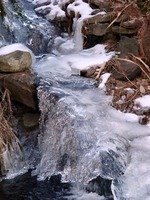
Plants aren’t the only item in your landscape to protect. Winter can do a number on your outdoor furniture. Secure it in a safe place, such as a garage or shed, or have a professional shrink wrap it for you. Even your boat can be shrink wrapped.

Remember to have a professional blow out irrigation and pool lines to prevent damage from water freezing and thawing in the lines throughout the season. Drain and cover any fountains. Talk to a professional for pond care and winterization if you have animals in the pond. Hungry birds and raccoons can make a meal out of unsuspecting koi and goldfish when the weather turns nasty.
https://gandr.impideas.net/wp-content/uploads/2012/10/17801838-20568220-thumbnail.jpg 150 150 Goldberg and Rodler https://gandr.impideas.net/wp-content/uploads/2026/02/GandR_logo_800.png Goldberg and Rodler2012-10-09 11:14:152019-04-02 19:37:27Just A Few More Things About Fall

Bulbs, Bulbs, Bulbs!

October 4, 2012/in Planting, Curb Appeal /by Goldberg and Rodler

I got a great question today about bulbs: “What is a bulb’s life span? How many years before I have to replant?”

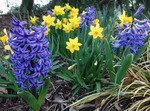
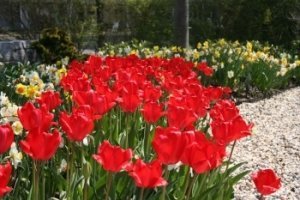
Red Tulips & Mixed DaffodilsIt depends on the type of bulb. Daffodils should multiply and come back every year, tulips you might get a few years out of but they will never be as nice as the first year. Bulb growers cut the flowers off and ship the bulbs the next year with all that extra energy stored inside. Daffodils are the only critter resistant bulb, so if you have a ton of squirrels or deer, stick with them or plant your tulips under chicken wire so they can’t dig them up.

I’m crazy about bulbs, they’re one of my favorite plants because I like to make arrangements with them all over my house. I add something to my yard every year! There are so many different varieties out there. Make sure you plant them at the right depth and water thoroughly after. A nice deep fertilization after they’re done blooming can help them store up energy for the next season.

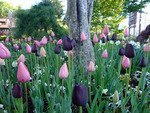
Tulips, Pansies, DaffodilsAs far as designs go, I love to mix and match and plant big masses. Use light and dark combinations of tulips to play off each other, such as light and dark pink. Daffodils come in so many colors, sizes and bloom periods now you can have a garden of just daffodils for months! Fragrant daffodils make great cut flowers.

Snowdrops bloom quite possibly when snow is still on the ground. Crocus come up next and let us know spring is here. Hyacinths show up around Easter & Passover. After that comes the riot of color from daffodils and tulips, then alliums to usher in the summer. The giant globe shape of some of the alliums make a statement in a bed of liriope or other groundcover. They also make for great cut flowers and you can let them dry out and have an arrangement all year.

Hyacinth & Early, Mini Daffodils (Tete a Tete)

Bulbs don’t need to be divided like perennials do for rejuvenation, but some bulbs will dig themselves deeper or into an awkward position which can inhibit growth and/or blooming. I turned over a bed of wood scilla (by happy accident when I was putting in new perennials and shrubs) that had been planted at least 15 years ago and it revived them and they’re blooming great now.

The key to a show stopping bulb display is massing. If there weren’t enough one year, add more for the next season. You can never have too many bulbs! They are probably the most cost efficient plant you can put in your garden, especially if you get a naturalizing variety which will multiply and bloom for many years.

Feel free to ask me any questions and get those bulbs in before the ground freezes!


https://gandr.impideas.net/wp-content/uploads/2012/10/alliums.jpg 325 600 Goldberg and Rodler https://gandr.impideas.net/wp-content/uploads/2026/02/GandR_logo_800.png Goldberg and Rodler2012-10-04 13:17:312019-04-02 19:37:34Bulbs, Bulbs, Bulbs!

Zucker Hillside Hospital: Commercial Landscape Overhaul

October 3, 2012/in Planting, Commercial /by Goldberg and Rodler

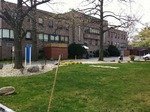
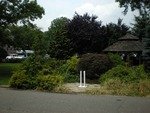
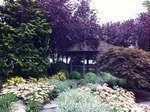
Robert Rodler started working at Hillside Hospital before Goldberg & Rodler even existed with J. J. Levison. Levison handed it over to Goldberg & Rodler in the early sixties and we did a ton of work there. Then we did bits and pieces here and there, sprays, tree work, etc. until 2009. The new facilities manager wanted the campus renovated and he contacted us. Maintenance had been getting progressively worse, to the point where the campus was covered in poison ivy, the original design was almost impossible to discern. You can still see the cherry trees, dogwoods and sycamores on the campus that we planted back in the 60’s but they were in desperate need of pruning. Limbs wider than a person’s leg were dropping dangerously to the ground. The baseball field, apple orchard and formal rose garden had been razed for additional parking as the facility grew. Increased paving was causing massive drainage issues. People would park anywhere they could find a spot, including on the grass, off the road in the woods, there were no curbs or barriers to prevent it. It was unrecognizable and a perfect example of how maintenance issues can affect more than the landscape. Employees and family member’s of patients were extremely unhappy. There was no place to eat or take a break, no place for people to sit, the gazebo was unsafely enclosed by overgrown plants, and one building was hidden behind overgrown yews.

Our first job was the poison ivy removal and pruning and removing hazards in the trees. People had been dumping garbage in the woods so our next task was to clean that up. We redesigned several areas, focusing on the core and most visible parts of the campus first. We fixed the drainage issues so they no longer had to pile sandbags in front of the doors (it isn’t recommended by health professionals to block hospital doors, in case of emergencies) or deal with a mosquito farm in a swampy lawn area. Many overgrown plantings needed pruning for security reasons, who wants to eat lunch completely enclosed on all sides so you can’t see who is approaching? We added curbs and boulders to the areas people were driving and parking in that were unpaved. We made elegant gravel shapes and used water tolerant plantings in areas where runoff collected.

We sited a lot of trees as part of the Million Trees Project in NYC’s boroughs. We redesigned outdoor recreation areas for the patients. We transplanted and relocated plants for the construction happening on the campus. We even installed fountains in the lobby with interior plants. Right now we’re working on designs for patients’ roof gardens and a parking lot to add more parking. It’s in Queens, there’s never any parking!

https://gandr.impideas.net/wp-content/uploads/2012/10/17801838-20439665-thumbnail.jpg 112 150 Goldberg and Rodler https://gandr.impideas.net/wp-content/uploads/2026/02/GandR_logo_800.png Goldberg and Rodler2012-10-03 16:14:002019-04-07 21:30:55Zucker Hillside Hospital: Commercial Landscape Overhaul

Fall & Winter Services

September 28, 2012/in Planting, Curb Appeal, Maintenance, Commercial /by Goldberg and Rodler

Sign up now for our Fall/Winter Services. If you haven’t given a thought to protecting your broadleaf evergreens yet, it isn’t too late! An anti-desiccant spray can reduce water loss through the leaves during a time when your plants can’t take in water from the frozen ground. Reapply in mid-winter.
Make sure your gutters are clear. During a heavy snowfall, ice dams can form and water may back up under the flashing behind the gutters. This can cause leaks and if not treated, mold growth.

Road salt can damage your plants. You won’t see the damage until Spring when it is too late. Make sure to pile contaminated snow away from your plants. Try calcium chloride; a less harmful chemical to melt the ice. Calcium is a nutrient plants can tolerate but still minimize the amount you put down.

2-3” of shredded bark or compost at the bases of trees and shrubs can insulate shallow roots and conserve moisture before the soil freezes. 

Make sure the flue is clear in your chimney so you can snuggle by the fire all winter.

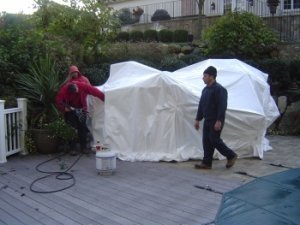
Did you wrap up or store your furniture? We offer shrink wrapping for outdoor furniture, barbecues, pots and even boats.

Who’s doing your holiday decorations and/or lighting? Sick of getting up on that ladder every year? Let us do it for you while you stay inside with a cup of hot cocoa.


https://gandr.impideas.net/wp-content/uploads/2013/09/SHRINKWRAP3.jpg 263 350 Goldberg and Rodler https://gandr.impideas.net/wp-content/uploads/2026/02/GandR_logo_800.png Goldberg and Rodler2012-09-28 18:33:002019-04-02 19:37:53Fall & Winter Services

The Time Is Now

September 24, 2012/in Planting, Maintenance /by Goldberg and Rodler

We’re already thinking about Memorial Day at Goldberg & Rodler. It’s a common deadline for landscape construction. People want to have parties, family gatherings, use their outdoor spaces to the fullest when the sun is shining. Our office gets flooded with calls when spring rolls around, usually when the crocus and daffodil pop up. Nobody thinks about summer flowers and sitting out on their decks and patios or going swimming when there’s snow on the ground. Get a head start with a landscape design in the fall or winter and you can break ground in the spring. Get a head start on construction and you can be having fun in the spring!

If you’re building a new home or an addition, think about installing screen planting now. As long as the trees and/or shrubs aren’t in the way of the contractors the plants will have a whole season’s head start on growing. When your construction is complete the screen planting will be there to provide privacy to enjoy your new space.

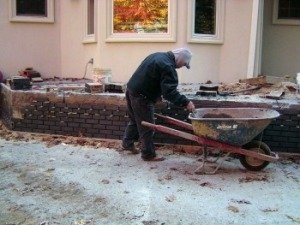
If you already have a plan and the ground hasn’t frozen yet, get a head start on the construction. If you have concrete work in your plans, start pouring before the winter sets in. Concrete takes a long time to cure and getting a jump on it helps when spring comes and you’re ready to set the pavers or mortar a veneer. It also allows time for the sub-grade and/or backfill to settle.

Fall is the time to start planning, planting and building. It gives you ample time to get necessary permits approved. If a permit is denied to either need to revise and resubmit or apply for a variance. Either way it is a long process. It never hurts to plan ahead! Once the weather warms up, you want to be out there enjoying your property, not watching from inside while it get’s ripped up and put back together.


https://gandr.impideas.net/wp-content/uploads/2012/09/inlay.jpg 225 300 Goldberg and Rodler https://gandr.impideas.net/wp-content/uploads/2026/02/GandR_logo_800.png Goldberg and Rodler2012-09-24 18:25:132019-04-02 19:38:20The Time Is Now

Autumn To Dos & Don’ts

August 28, 2012/in Planting, Maintenance /by Goldberg and Rodler
A few things to think about as cooler weather looms near.
Fall is the best time to seed your lawn. Depending on the variety, grass seed needs a temperature range of 45-65 degrees Fahrenheit to germinate properly. Make sure to water adequately while not overwatering and that the seeds is in contact with the soil. Birds LOVE grass seed. To protect your seed sprinkle a light dusting of compost over it. This will also help keep the seed moist.
Plant your bulbs before the ground freezes and water thoroughly after installation. They will wow you in the spring! Daffodils are critter resistant but tulips are on the menu for deer, squirrels and other furry friends. Crocus and wood scilla are the first to pop up, usually in March. Daffodils and tulips can range anywhere from March through late May. Alliums bloom later around June. Planned correctly, your garden will be a riot of color through every season.
DO NOT PRUNE YOUR TREES AND SHRUBS! Don’t be tempted to prune as it gets colder. Pruning forces tender new growth that can be destroyed by the upcoming freezing temperatures. Wait until spring or, even better, after the particular plant flowers so you don’t remove any buds on early bloomers like azaleas and rhododendrons. DO cut down your perennials and ornamental grasses.


https://gandr.impideas.net/wp-content/uploads/2012/08/IMG_1343.jpg 299 400 Goldberg and Rodler https://gandr.impideas.net/wp-content/uploads/2026/02/GandR_logo_800.png Goldberg and Rodler2012-08-28 15:05:552019-04-02 19:38:28Autumn To Dos & Don’ts

Green Roof = Sustainable Design

August 14, 2012/in Planting, Other /by Goldberg and Rodler
A green roof is just one of many steps toward more sustainable and environmentally friendly landscapes. We installed a green roof in Eaton’s Neck using the LiveRoof System. The residence is designed specifically for several green roofs; not just for aesthetic value but environmental as well.
Advantages:
– Soil and plant matter provides insulation for temperature & sound
– Reduces stormwater runoff by absorbing water
– Reduces air pollution & lowers the heat island effect with sedums that evapotranspirate at night
Pre-grown modular system:
– Minimal irrigation needs, especially once it is established
– Uses fire resistant succulent planting; plants retain moisture and are fit for arid conditions
– 25-50% energy savings
– Lightweight modules decrease load on roof
– Repair requires minimal disruption of system; trays can removed and replaced individually
– Plant choices offer visual interest all year round
https://gandr.impideas.net/wp-content/uploads/2012/08/Green-Roof-Outside-the-Kitchen-Window2.jpg 294 450 Goldberg and Rodler https://gandr.impideas.net/wp-content/uploads/2026/02/GandR_logo_800.png Goldberg and Rodler2012-08-14 12:37:002019-04-02 19:38:55Green Roof = Sustainable Design

Mulch Volcanoes

August 7, 2012/in Planting, Maintenance /by Goldberg and Rodler
PreviousNext
12

The quickest and least expensive way to clean up your property is to mulch the beds. Even if you don’t have any plants in them. It will give you a fresh and tidy look for your property and is something you can do yourself. However, if the beds DO have plants, make sure you know how to mulch around them properly. It can be a massive drain of time and money to fix improperly mulched plantings and if you can’t fix them you end up replacing them.

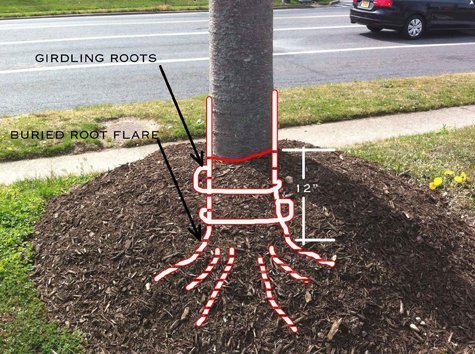
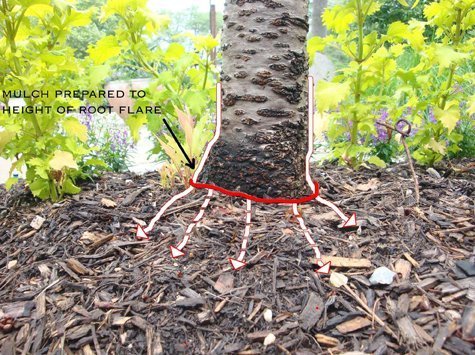
I see what we call, “mulch volcanoes,” way too often around trees and shrubs. That’s what we say when we see a pile of mulch around a tree trunk. I also see those plants declining after just one season of suffocation. This may seem dramatic, but piling mulch around the trunks of trees and shrubs WILL kill them. Roots need air and if the plant can’t get enough, it will send out adventitious roots to find them. If you can’t see a root flare, the plant won’t be able to breathe. Girdling roots start to form, wrapping their way around the trunk in a confused effort to find air. As the trunk of the tree or shrub grows and expands outward, these girdling roots press on the trunk and literally strangle it.

To prevent this from happening, make sure you mulch properly. You want to see a root flare out at the base of the trunk(s) like a bell bottomed jean (see pictures below). You DON’T want to see a mound of mulch. If you see a mound of mulch, it may not be too late. Pull the mulch away and dig out your tree or shrub. If it is truly planted too low you can try to transplant it higher when the time is right for that plant. Or you can dish out around it but remember you will essentially be creating a little sump area where the water will pool. If the girdling roots haven’t fused to the trunk you can remove them with pruning shears. This will most likely shock the plant but with some TLC it may come back.

I have seen it in my own yard. An azalea my mom planted 20 years ago had slowly sunk into the soil and years of mulching around it had buried it about 8 inches up the trunk. I thought it was dying because it was old and decrepit until I started poking around the base. I dug it out two years ago, transplanted it and cut it back to rejuvenate the shape. It now looks healthy and happy.

Feel free to ask me any questions or send me pictures if you think your plants are in trouble from the dreaded mulch volcanoes. Good luck!


https://gandr.impideas.net/wp-content/uploads/2012/08/goodmulch.jpg 355 475 Goldberg and Rodler https://gandr.impideas.net/wp-content/uploads/2026/02/GandR_logo_800.png Goldberg and Rodler2012-08-07 12:41:452019-04-02 19:39:03Mulch Volcanoes

Rain Gardens & Rain Barrels

July 12, 2012/in Planting, Maintenance /by Goldberg and Rodler
We all learned about the water cycle in elementary school. It rains, plants and soil soak up water, plants evapotranspirate moisture back into the atmosphere and standing water evaporates, it rains. That’s the simplified version. In reality, in our developed world, it takes a lot more steps for the water to go from the clouds to the ground again. Sewers, drains, and drywells capture runoff from impervious surfaces like asphalt, concrete and roofs and this water is either contained until it can slowly migrate back into the soil through the perforated wall of a concrete drywell, or it is sent to a sewage treatment plant to be treated with chemicals and reintroduced into our water cycle. The more impervious surfaces that cover our earth, the more water that is treated and wasted.
How can we lessen the impact on our drainage systems? Rain gardens. Let the soil and plants naturally filter out impurities and toxins from the runoff, as in other unpaved areas, and have a beautiful, diverse garden to enjoy. Sure, you can get a backhoe and even a crane to come in and dig down until you hit drainable material, then install drywells, and surface drains, but that is expensive. While it is currently the accepted way to deal with storm water runoff, it adds yet another step to a natural process that worked fine before human intervention.
You can also try a rain barrel. Hook one up to your downspout and use it for irrigation. Why pay the water company for treated water when you can collect it unpolluted for free? Some water tolerant (aka “likes wet feet”) plants for these areas would be acorus, clethra, iris, daylily, bog rosemary, hypericum, and willow among others.
https://gandr.impideas.net/wp-content/uploads/2012/07/Rain-Garden.jpg 293 460 Goldberg and Rodler https://gandr.impideas.net/wp-content/uploads/2026/02/GandR_logo_800.png Goldberg and Rodler2012-07-12 22:57:512019-04-02 19:39:34Rain Gardens & Rain Barrels

The Garlic & Vinegar Solution

June 1, 2012/in Planting, Maintenance /by Goldberg and Rodler

No, this isn’t a post about cooking. It is about using everyday kitchen ingredients to keep the weeds and creepy crawly biting things away. I don’t like using chemicals on my property. I don’t like weeds or bugs. I don’t want to harm myself or my pets with toxic chemicals. What’s a girl to do? Go to the grocery store! Vinegar is about 3 dollars for a gallon jug, garlic is 25 cents per bulb and mineral oil is around $5, depending on the size and quality you want to use. If you’re not going to eat it, get the cheaper stuff!

Vinegar is a non-selective, organic herbicide. A few of my neighbors’ aren’t as attentive with their properties as I am with mine and their weeds are constantly creeping under the fence. Every year I buy a few gallons of vinegar and pour it along the fence line. I am careful not to splash my existing plants, because like I said before, it is non-selective, which means it will kill any plant, not just the weeds. It won’t destroy heavy hitters like English Ivy, Morning Glory Vine, Crabgrass or Dandelions, but it weakens them enough for me to rip them out more easily. Organic yards take a lot of one on one work, but it is worth it to me.

I’m fine with most insects but my hospitality runs out when mosquitoes use me and mine as a snack bar. Garlic oil is a good mosquito repellant. You could rub it on yourself but that’s going to be rather awkward smelling. It is better to apply it to the garden, as a perimeter application, and it has the bonus effect of deterring bunnies from the yard as well. I’m not going to claim that this will take care of all the mosquitoes, but for my purposes, it does a decent job of protecting me and my pets. See the recipe below to make your own.

You can repurpose the vinegar jugs when you’re done, using them as planters, watering containers, or to keep your garlic oil in!

Garlic Oil

Ingredients:
1 head of Garlic
1 cup Mineral Oil
1 tsp. Lemon Juice
2 cups Water

Instructions: Mince several cloves of garlic and cover with mineral oil. Let it sit for at least 24 hours to infuse. Take about 1 teaspoon of the oil (I strain the garlic chunks out with wire mesh) and mix it with 2 cups of water and 1 teaspoon lemon juice in a spray bottle. Shake it up well and go to town! Store extra in a cool, dry place. You won’t be cooking with it but no need to let it get any funkier. I usually make mine each time I need it.

https://gandr.impideas.net/wp-content/uploads/2012/06/vinegar.jpg 360 360 Goldberg and Rodler https://gandr.impideas.net/wp-content/uploads/2026/02/GandR_logo_800.png Goldberg and Rodler2012-06-01 17:44:002019-04-02 19:39:44The Garlic & Vinegar Solution
Page 6 of 7«‹4567›

BACK TO MAIN BLOG

SEARCH BLOG

BLOG CATEGORIES

  • Outdoor Planning
  • Planting
  • Outdoor Kitchen
  • Stonework
  • Curb Appeal
  • Patio
  • Pool Area
  • Woodworking
  • Maintenance
  • Commercial
  • Other
  • 216 East Main Street, Huntington, NY 11743

  • 631-271-6460
  • Contact Us
  • Facebook
  • Instagram

© 2026 Goldberg & Rodler, Inc. All rights reserved.

Scroll to top